Marketing Attribution: The Honest Guide We Hand to New Clients
Every ad platform says it drove the sale, and the sum of their claims is bigger than your revenue. This is how we explain marketing attribution to new clients, and how we make budget decisions when the numbers will never fully agree.

Key takeaways
- Marketing attribution is a set of rules for sharing credit, not a record of what caused a sale. Treat every model as an opinion with a known bias.
- Ad platforms grade their own homework, so the same order is often claimed by Meta, Google and TikTok at once. Your backend revenue is the only total that cannot be double counted.
- Data-driven attribution in GA4 and Google Ads is a sensible default, but it only redistributes credit among touches it can see.
- Incrementality tests and holdouts answer the question attribution cannot: would this sale have happened without the ad?
- Match the stack to your size. Small brands need clean tracking and a blended cost per acquisition; larger spenders add tests and, eventually, media mix modelling.
01What marketing attribution can and cannot tell you
Most of the attribution conversations we have start the same way. A founder opens Meta Ads Manager, then Google Ads, then GA4, then Shopify, and the four numbers for last month’s sales look like they came from four different businesses. The question is always some version of “which one is lying?” Our answer tends to surprise people: none of them is lying, and none of them is telling you the whole truth either. That gap is what marketing attribution tries to manage.
Here is the plain definition we use with clients. Marketing attribution is the process of assigning credit for a conversion to the marketing touches that came before it. It is a set of rules. Some rules are simple (give everything to the last click), some are statistical (share credit based on patterns across thousands of paths), but they are all rules someone chose. Attribution describes the path. It does not prove that any single step caused the purchase.
That distinction matters more than any model choice. A retargeting ad shown to someone already sitting in their basket will look brilliant in almost every attribution report, because it is always present right before the sale. Whether it changed anything is a separate question, and one that attribution alone cannot answer.
The three questions attribution is actually good for
- Which paths are common? Seeing that most buyers touch a search ad, then an email, then return direct, tells you how people shop.
- Which channels start conversations and which close them? Useful for setting different targets for prospecting and retargeting.
- Where is tracking broken? A sudden rise in direct or unassigned traffic is usually a tagging problem, not a change in customer behaviour.
02Marketing attribution models, explained without the jargon
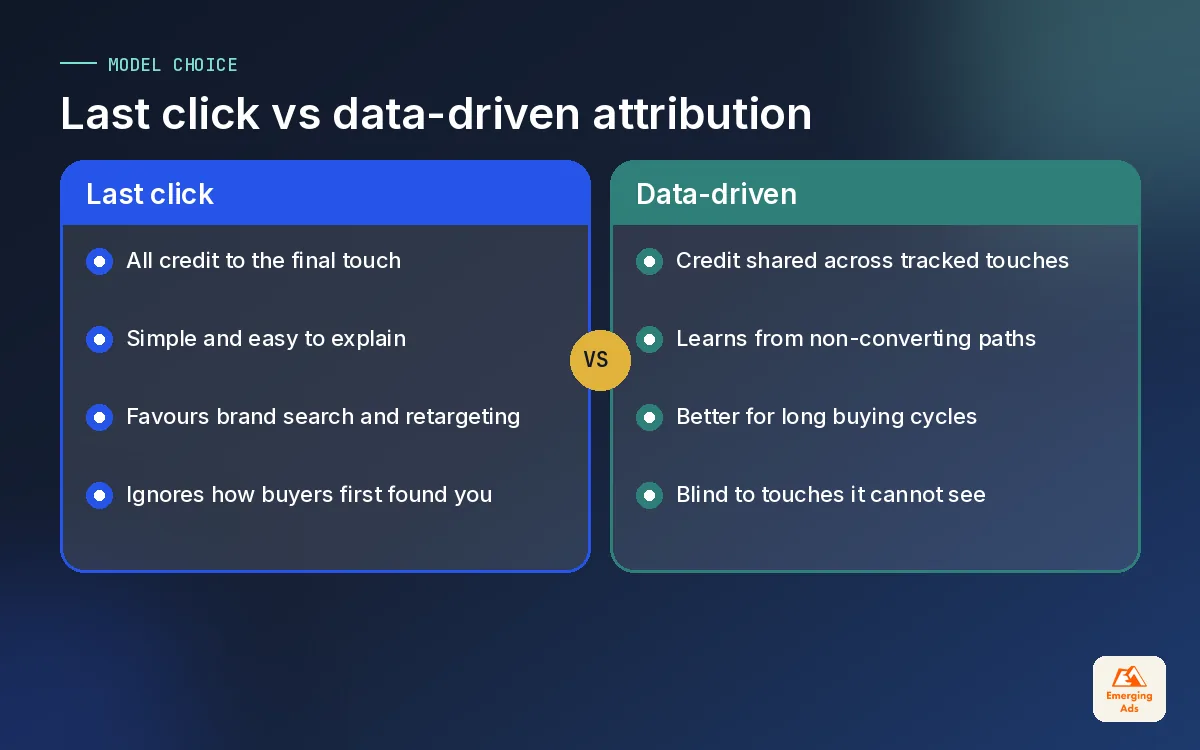
There used to be a long menu of rules based models in Google’s tools. In 2023 Google removed first click, linear, time decay and position-based attribution from GA4 and Google Ads, leaving data-driven and last click. You will still meet the old models in third-party tools and in older blog posts, so it helps to know what each one believes.
| Model | What it believes | Where it misleads you |
|---|---|---|
| Last click | The final touch before purchase did the work | Undervalues anything that introduced the buyer, overvalues brand search and retargeting |
| First click | Whatever started the path deserves the credit | Ignores the follow up that turned interest into a sale |
| Linear | Every touch counts equally | Treats a two second video view the same as a product demo |
| Position based | First and last matter most, the middle shares the rest | The split is arbitrary, usually 40, 20, 40 |
| Data-driven | Credit follows statistical patterns in converting and non-converting paths | Only sees touches that were tracked, and the logic is not fully visible |
Last click vs data-driven: which should you use?
For most accounts we manage, data-driven attribution is the sensible default in both GA4 and Google Ads. It compares paths that converted with paths that did not, then shares credit accordingly. That is a genuine improvement on handing everything to the final click, especially for businesses with long consideration periods such as B2B software, clinics or high ticket furniture.
The catch is what it cannot see. Data-driven attribution only redistributes credit among the touches that were recorded. If a buyer heard about you on a podcast, saw a TikTok on a friend’s phone and then searched your brand name, the model sees one brand search and gives it everything. Clean inputs matter far more than the model itself, which is why a proper GA4 setup and consistent UTMs come before any debate about models.
Multi-touch attribution in third-party tools
Tools such as Hyros and RedTrack build their own multi-touch attribution by stitching clicks, sessions and orders together, often with server-side capture. They can be very useful for brands spending heavily across several paid channels, particularly info products and direct response offers. We set up Hyros tracking and attribution and RedTrack ad tracking for clients where the platforms’ own reports have become impossible to reconcile. They are still models, though, and they still need testing against reality.
03Why every platform claims the same sale
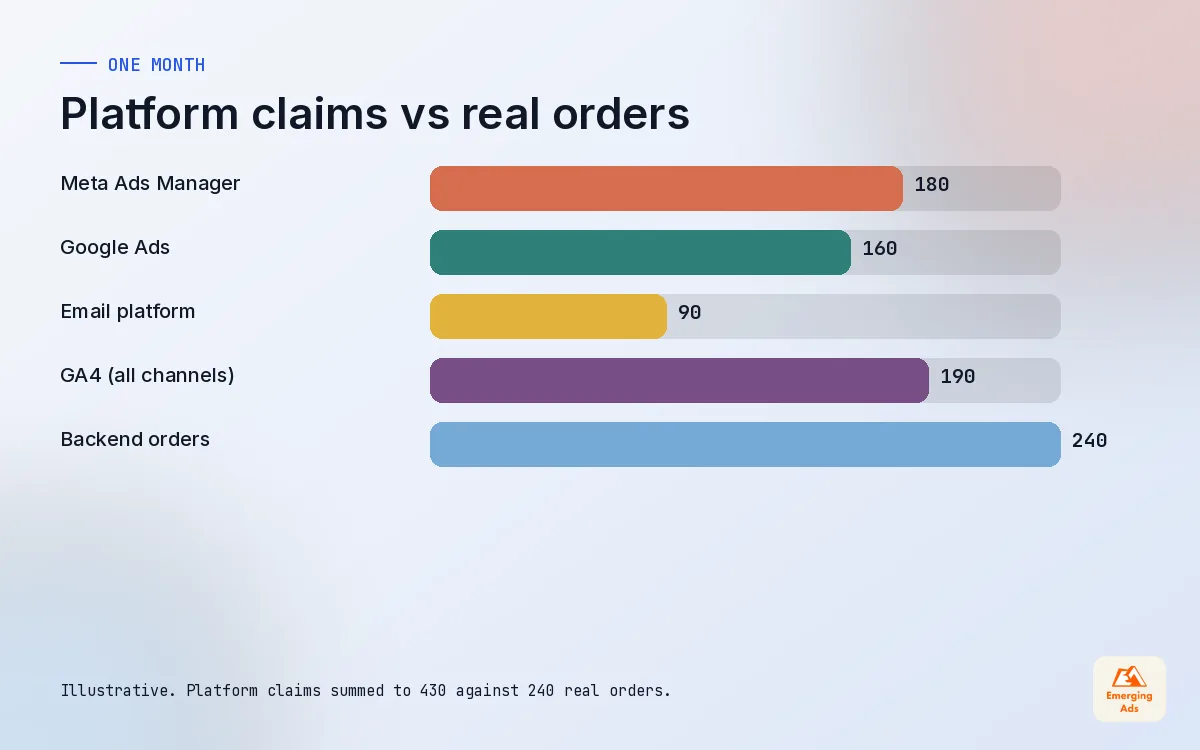
This is the single most common source of confusion we see. A customer clicks a Google Shopping ad on Monday, watches a Meta video on Wednesday, and buys on Thursday. Google Ads counts a conversion. Meta counts a conversion. If they also opened a Klaviyo email, that tool counts one too. Your store recorded one order. Add up the platforms and you have sold three.
Each platform uses its own attribution window, its own definition of a touch (clicks, views, engaged views) and its own identity graph. None of them can see the others’ ads. So each one reports, honestly by its own rules, that it contributed. The overlap is invisible from inside any single dashboard.
Self-attribution is not fraud, but it is biased
We do not think the platforms are inventing conversions. We do think they have every incentive to count generously, and view-through conversions in particular deserve scepticism. A view-through means someone was shown an ad and later bought. For a brand with strong organic demand, plenty of those people would have bought anyway.
| Source | What it counts | Typical bias |
|---|---|---|
| Meta Ads Manager | Clicks and views within its chosen windows | Generous on view-through, strong on prospecting credit |
| Google Ads | Clicks, and engaged views for video | Brand search and Performance Max can absorb demand created elsewhere |
| GA4 | Sessions it can see, with data-driven credit | Misses view-only touches and loses users to consent and cookie limits |
| Shopify or CRM | Actual orders and revenue | Accurate totals, weak on which channel caused them |
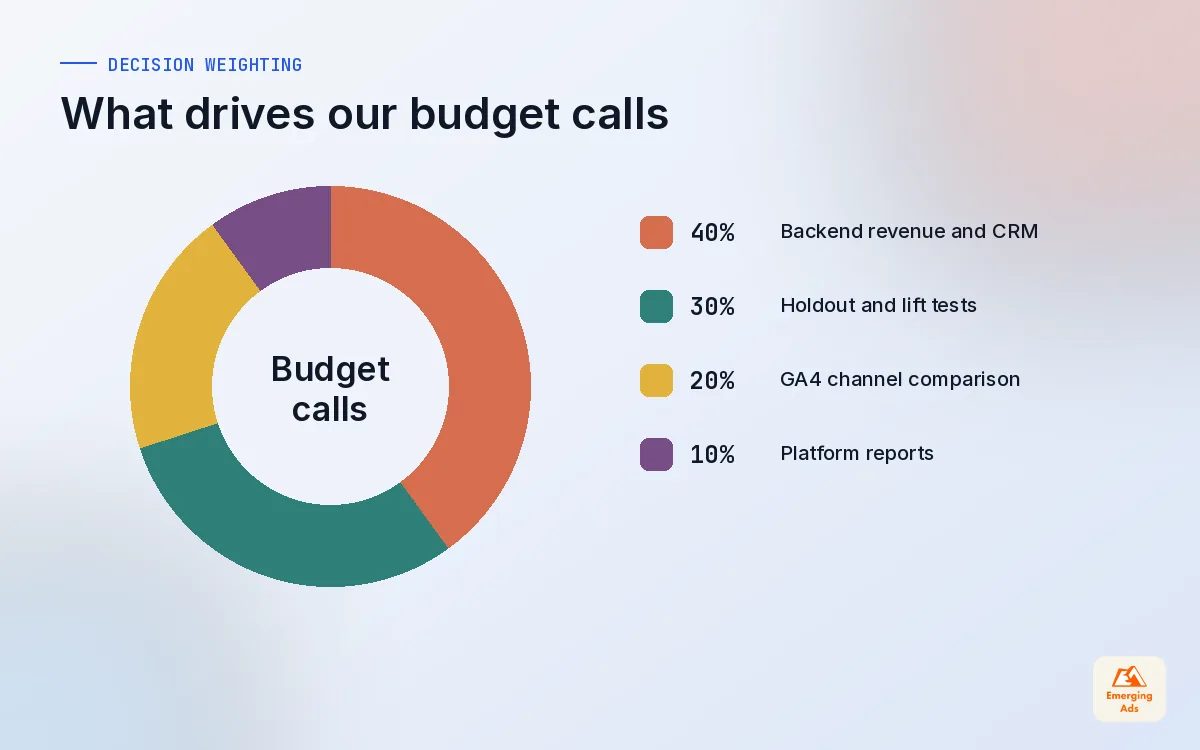
The practical fix is not to pick one platform and ignore the rest. It is to agree which source is the truth for which question. Backend revenue is the truth for totals. Platform data is useful for optimising inside that platform. GA4 is the neutral referee for comparing channels on one set of rules. Once you frame it like that, the numbers stop feeling like a contradiction.
Your platforms can all be right about their own contribution and still add up to more money than you made.
04GA4 vs ad manager numbers: reconciling them without losing your mind
When a client asks us why GA4 shows fewer conversions than Meta, we walk through the same short list. Nine times out of ten the gap has an ordinary explanation, and once it is written down, the monthly panic stops.
- Different windows. Meta might credit a purchase seven days after a click and one day after a view. GA4 has its own lookback and ignores views entirely.
- Different dates. Ad platforms often report conversions against the day of the click. GA4 reports against the day of the conversion.
- Consent and blockers. Users who decline cookies or run blockers are partly invisible to GA4. Consent Mode v2 helps Google model some of this, but not all of it.
- Cross-device paths. A click on mobile and a purchase on a laptop can be connected by Meta’s logged-in users but not by GA4.
- Broken tagging. Missing UTMs, a payment gateway overwriting the referrer, or a duplicate purchase tag. These are the gaps you can actually fix.
We work through these in order during every conversion tracking setup project. The first four you document and accept. The fifth you fix, and fixing it often closes more of the gap than people expect. If you have not already, read our walkthroughs on setting up GA4 properly and on the Meta Conversions API, because both change how many conversions each side can see.
05Incrementality testing: the question attribution cannot answer
Attribution tells you who was present. Incrementality tells you who made a difference. An incrementality test compares a group that saw your ads with a similar group that did not, then measures the gap in conversions. That gap is the lift your advertising actually created.
Three test designs we use on client accounts
- Platform conversion lift studies. Meta and Google offer lift studies on eligible accounts. They randomise who sees ads and who is held out. Good for testing a whole channel, but they need enough spend and volume to read clearly.
- Geographic holdouts. Pause or cut spend in a set of matched regions while keeping others running, then compare sales. Works well for brands with national reach and a backend that records location.
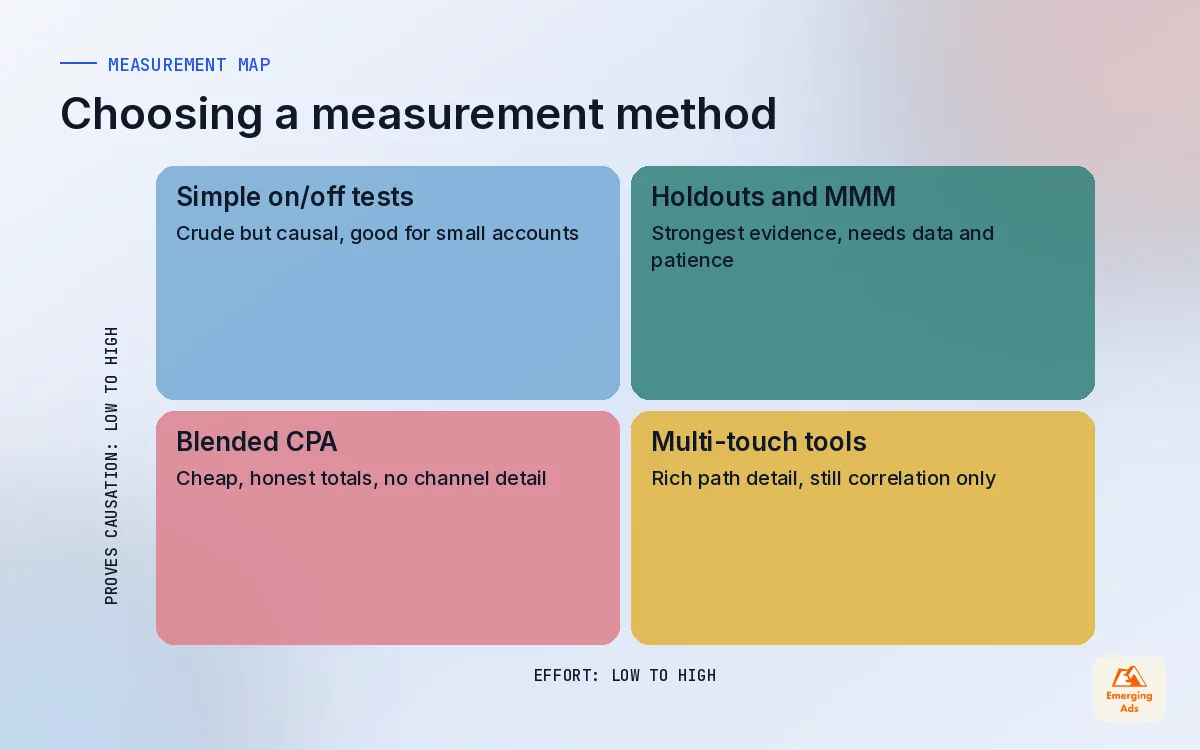
- Time based on and off tests. Switch a campaign type off for a few weeks and watch total revenue. The crudest method, and noisy, but sometimes the only option for smaller accounts. Retargeting and brand search are the classic candidates.
Our honest experience is that the results are often humbling. Brand search campaigns and heavy retargeting frequently show much less lift than their attributed numbers suggested, while upper funnel video that looked weak in last click reports sometimes holds up better than expected. Not always, and that is exactly why you test rather than assume.
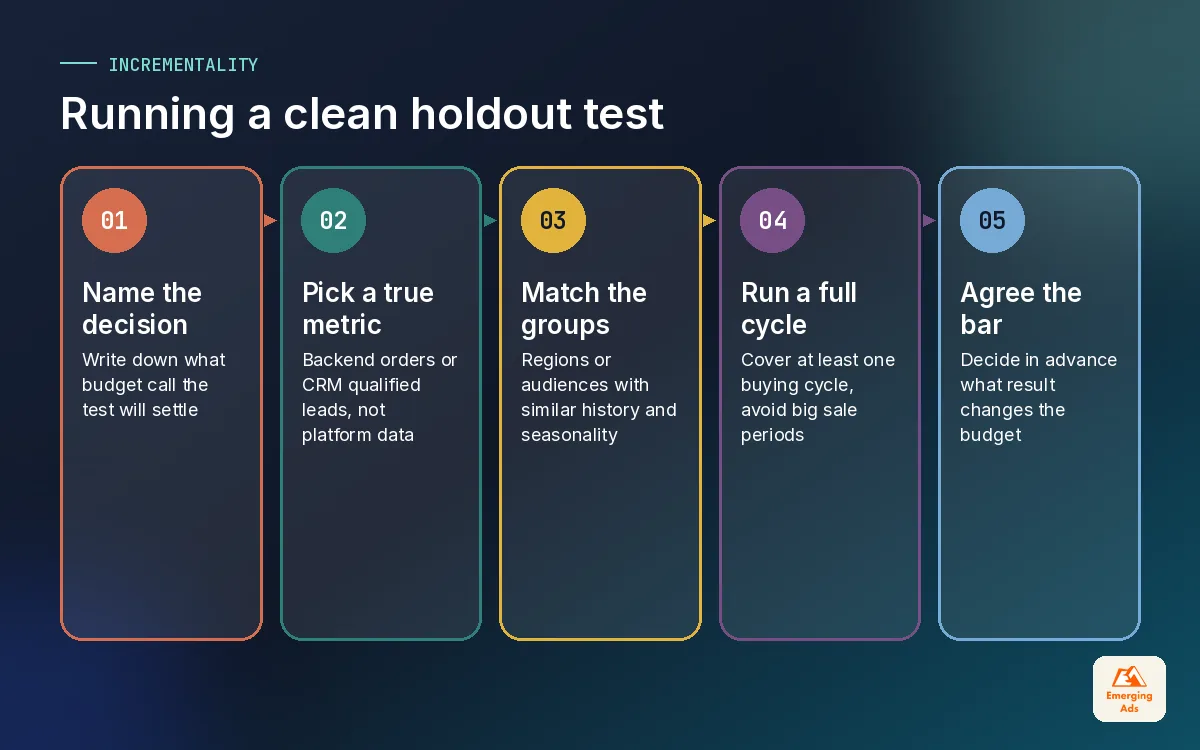
How to run a clean holdout
- Write down the decision the test will inform before you start, for example “should we keep spending on brand search at this level?”
- Choose a metric you trust, usually backend orders or qualified leads from the CRM, not platform conversions.
- Pick matched groups or regions with similar history and seasonality.
- Run it long enough to cover at least one full buying cycle, and avoid major sales periods.
- Agree in advance what result would change your budget, so nobody reinterprets the numbers afterwards.
06Media mix modelling in plain terms
Media mix modelling, usually shortened to MMM, takes a completely different route. Instead of following individual users, it looks at weekly spend by channel alongside weekly revenue over a long period, plus outside factors like seasonality, pricing and promotions. It then estimates how much each channel contributed, including the effect that carries over from past weeks.
Because MMM needs no cookies or user level tracking, it is immune to consent banners and browser restrictions. That is why interest in it has grown again. Open source options such as Google’s Meridian and Meta’s Robyn have made it more accessible, though you still need someone who understands the statistics and, just as importantly, the business.
When MMM is worth it, and when it is not
We generally only suggest MMM when a brand has at least two years of reasonably consistent data, spends across several channels, and has enough variation in spend to learn from. A business that has spent the same amount on one channel every week gives the model nothing to compare. For most small and mid-sized clients, well run holdout tests deliver more practical value for the money.
07A practical marketing attribution stack by business size
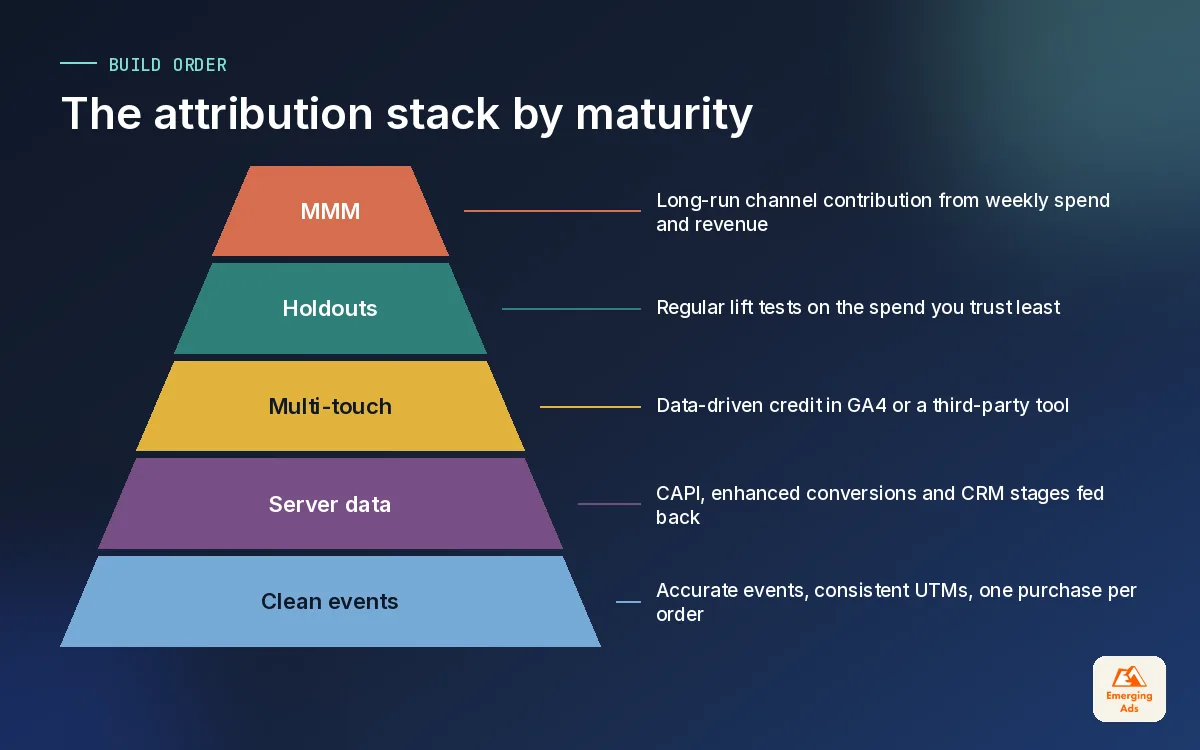
There is no single right setup. What we recommend depends on spend, channel count and how long people take to buy. This is the rough ladder we use when scoping attribution modelling work for a new client.
| Stage | Typical situation | What we put in place |
|---|---|---|
| Getting started | One or two paid channels, modest spend | Clean GA4, consistent UTMs, accurate purchase or lead events, blended cost per acquisition |
| Growing | Three or more channels, spend rising | Server-side signals, Meta CAPI, enhanced conversions, CRM stages fed back to ad platforms |
| Scaling | Significant multi-channel spend | Regular holdout tests, a third-party attribution tool where it adds clarity, BigQuery export |
| Mature | Large budgets across online and offline | MMM alongside tests and attribution, with a clear rule for which method settles which decision |
Notice that the first two stages are mostly about data quality. We see plenty of businesses buying sophisticated attribution software to sit on top of tracking that double fires purchase events. Fix the foundations first. Our guide to server-side tracking covers the plumbing that every later stage depends on.
Lead generation businesses need one extra layer
If you sell through a sales team, the conversion that matters happens in the CRM, sometimes weeks after the form fill. Without passing lead stages and deal values back to the ad platforms, both attribution and bidding optimise for form fills, including the junk ones. That is why CRM automation setup is part of almost every attribution project we run for B2B and service clients.
08Making budget decisions with imperfect data
Here is the part nobody likes to hear: you will never have perfect marketing attribution. Consent rules, cross-device behaviour, word of mouth and offline conversations make sure of that. The goal is not certainty. The goal is to make better decisions than you would without the data, and to know how confident you should be in each one.
The weekly and monthly routine we use
- Weekly: watch blended cost per acquisition (total spend divided by total backend orders or qualified leads). If it holds steady while spend rises, the mix is working, whatever each platform claims.
- Weekly: optimise inside each platform using that platform’s own numbers. That is what its algorithm is trained on, so it is the right data for that job.
- Monthly: compare channels in GA4 on one set of rules, and look for trends rather than exact matches.
- Quarterly: run at least one incrementality test on the channel you are least sure about.
Tie this together in a single report rather than five logins. A shared Looker Studio dashboard that shows backend revenue next to platform claims makes the overlap visible and stops the weekly argument about whose number is right. On the buying side, our Meta ads management and Google Ads management teams work from that same view, so budget shifts are based on blended results rather than whichever platform shouts loudest.
09Where to start this week
If your attribution feels like a mess, do not start by choosing a model. Start by writing down your backend revenue for last month, then the conversions each platform claimed, and calculate how much they overlap. That one exercise usually changes how a leadership team talks about marketing. Then check the basics: are UTMs consistent, is the purchase or lead event firing once and only once, and are CRM outcomes flowing back to the platforms?
Once the foundations are solid, pick one channel you have doubts about and design a small holdout. You will learn more from that single test than from another month of staring at attribution reports. For more on how we approach tracking and measurement, visit the whyemergingads.com homepage. If you want a sense of cost before you commit, the main site has a clear breakdown of what attribution modelling costs, and you can see how measurement fits alongside media buying in the full list of EmergingAds services.
Frequently asked questions
Straight answers to what clients ask us most about marketing attribution.
What is marketing attribution?
What is the best marketing attribution model?
Why do Meta and Google both claim the same conversion?
Why does GA4 show fewer conversions than my ad platforms?
What is multi-touch attribution?
What is incrementality testing in marketing?
How is media mix modelling different from attribution?
Do small businesses need marketing attribution?
Should I trust view-through conversions?
How do I make budget decisions if attribution is unreliable?
How does attribution work for lead generation businesses?
How long does it take to set up marketing attribution properly?
Tired of five dashboards telling five different stories?
We will line up your ad platforms, GA4 and backend revenue side by side and show you which numbers to trust for which decision. Plain answers, no black box.
Book your free audit